
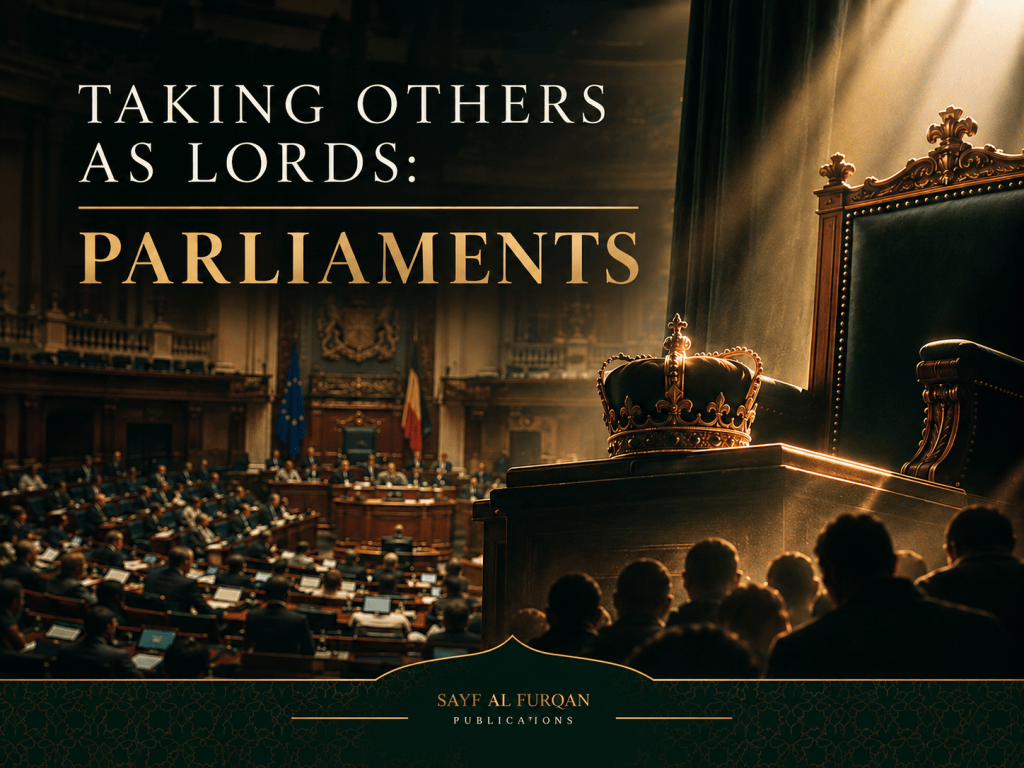
In every Muslim country today there is a building where a few hundred people vote on what citizens may do and what they must avoid, and once the votes are counted the result becomes law, enforced by police, courts and schools on everyone, whatever the Quran and the Sunnah say about the same matter. Most people pass that building without sensing anything religious in it, since it looks like ordinary administration, yet Allah described this very relationship between people and their lawmakers in Surah at Tawbah and named it taking others as lords. The question here is whether a parliament that claims the right to make any law it wishes occupies the position that the verse condemns in the rabbis and monks, and the evidence from the Quran, from the Prophet ﷺ and from the scholars of the Ummah shows that the principle of such an institution falls under the verse. This judgement concerns the system and its principle, and it leaves the verdict on each individual person who lives inside the system to Allah.
A few terms need to be fixed first. The word rabb (lord) names the one who owns, arranges and commands, Ibn Kathir shows how central lawmaking is to lordship when he explains the end of the verse, since the One whom people are commanded to worship is the One whose prohibition is final. Ibn Kathir said:
“whatever He legislates is followed, and whatever He rules is carried out.”
The ahbar are the scholars, while the ruhban are the devoted worshippers who withdrew from people to give themselves to worship, as al Saadi explains, so the verse speaks about two kinds of people whom others trust because of their knowledge or their piety. Tashri (legislation) means setting what is lawful and unlawful, and ibadah (worship) includes obedience in that field, which the hadith below makes clear. The modern counterpart in this matter is the legislature. The jurist A. V. Dicey described its authority and said: “the right to make or unmake any law whatever.”
The Evidence from the Quran and the Sunnah
Allah says:
ٱتَّخَذُوٓا۟ أَحْبَارَهُمْ وَرُهْبَـٰنَهُمْ أَرْبَابًا مِّن دُونِ ٱللَّهِ وَٱلْمَسِيحَ ٱبْنَ مَرْيَمَ وَمَآ أُمِرُوٓا۟ إِلَّا لِيَعْبُدُوٓا۟ إِلَـٰهًا وَٰحِدًا ۖ لَّآ إِلَـٰهَ إِلَّا هُوَ ۚ سُبْحَـٰنَهُۥ عَمَّا يُشْرِكُونَ
“They have taken their rabbis and monks as well as the Messiah, son of Mary, as lords besides Allah, even though they were commanded to worship none but One God. There is no god [worthy of worship] except Him.”
When Adi ibn Hatim, who had been a Christian before Islam, heard the Prophet ﷺ recite this verse he objected that his people never worshipped their scholars, the Prophet ﷺ said: “Don’t they forbid what Allah allows, so you forbid it?” A second question followed about permitting what Allah forbids, Adi agreed to both, and the Prophet ﷺ told him that this is what worshipping them means. In the version that Ibn Kathir narrates, the Prophet ﷺ said: “This is how they worshipped them.” The hadith therefore defines worship in this verse as obedience in the lawful and the unlawful, so that a person can be a worshipper of someone without ever bowing to him.
Imam Ibn Taymiyyah explains that those who obeyed their leaders in making lawful what Allah forbade and forbidding what He made lawful fall into two groups, the first group consists of people who know that the leaders changed the religion of Allah and still follow them in the change, which is kufr. Ibn Taymiyyah said: “[Allah and His Messenger] made it shirk even if they never prayed or prostrated to them.” The passage is found in his Majmu al Fatawa. The weight of this explanation lies in its last clause, since it removes the argument that obedience in lawmaking is a lesser matter than ritual worship.
Al Shanqiti carried this principle into the field of lawmaking in Adwa al Bayan. Al Shanqiti said:
“Shirk in Allah’s ruling is like shirk in His worship.”
His evidence comes from the Quran itself, which says of Allah that He lets none share in His rule, and which asks about lawmakers of other systems whether they are partners who instituted for the people a religion that Allah never permitted. He also points to the ruling Allah gave in Surah al Anam about people who obeyed a law that contradicted His own: “and if you obey them, you would be polytheists” Al Shanqiti then invites every reasonable person to compare the qualities that the Quran gives to the One who holds the right to legislate with the qualities of those who write human made laws, and to stop those lawmakers at the level of creatures instead of lifting them to the position of lords.
How the Verse Applies to Parliaments
A parliament matches this description in its structure. Dicey’s formula grants Parliament the right to make or unmake any law and adds that no person or body is recognised as having the right to override its acts, while Article 36 of the Belgian Constitution, to take one example, places federal legislative power jointly in the hands of the King, the House of Representatives and the Senate, which means that the final source of lawful and unlawful in that system is a vote and the people who cast it. A body with that mandate can permit lending at interest, which Allah forbade, and can forbid what He commanded, so the position it occupies is the position that the verse gives to Allah alone, the position of the One whose permission is permission and whose prohibition is prohibition. About human made laws and ruling by them, Muhammad ibn Ibrahim Al al Sheikh said: “the worst, the most obvious and comprehensive opposition to sharee‘ah.”
Islam Q&A counts the putting of the Shariah to a parliamentary vote among the signs of major kufr, since it makes the application of Allah’s law depend on a majority.
Every nation state with its own parliament writes its own law for its own territory, so the single Ummah that Allah addressed is cut into dozens of legal orders, each claiming final authority over its people. Allah commanded the believers to hold firmly together to the rope of Allah and to avoid division, and reminded them that He united their hearts so that by His grace they became brothers (3:103). He also says that this religion of the prophets is one (21:92). A command to hold together joined to a prohibition of division gives an obligation in the strongest form that the language of revelation has, and the obligation reaches the shape of authority itself, since the Prophet ﷺ taught that after him there would be caliphs, and when the Companions asked what he commanded in that case he told them to fulfil the pledge to the first and then to the first after him. In another hadith he ordered that when a pledge is given to two caliphs, the one who received it later is to be killed, which shows how firmly the Shariah protects a single leadership for the Ummah.
What we should do follows from this evidence. Muslims should remove from their hearts and their speech the idea that any assembly holds the right to decide what is lawful and unlawful, and should study the verse and its explanation well enough to teach it to their families and communitie. They should refuse obedience in whatever contradicts what Allah revealed while keeping their work for change open. They should keep the brotherhood that Allah describes in Surah Al Imran above every flag and border, and work with every sincere Muslim for the one Ummah under one rule by the Book of Allah, which is the setting in which the right of legislation returns to Allah in practice.
Our duty is to give the right of legislation back to Allah in our hearts, in our words and in our political work, to teach this verse to the next generation with its true explanation, and to strive for the unity of the Ummah under the law of its Lord.
Wa’Allāhu Aʿlam
Sayf Al-Furqan Publications
About UsSayf Al-Furqan PublicationsAuthorCaliphate Defence ForceTiktok; Caliphate Defence ForceInstagram;Caliphate Defence ForceYoutube; Iftira Tarih Utansin | Twitter;Talha Ibn YusufUpscrolled; Caliphate Defence ForceScribd;Caliphate Defence ForceWebsite; Hayatimanvecihad8Cdfnews7 |



Bir Cevap Yazın