
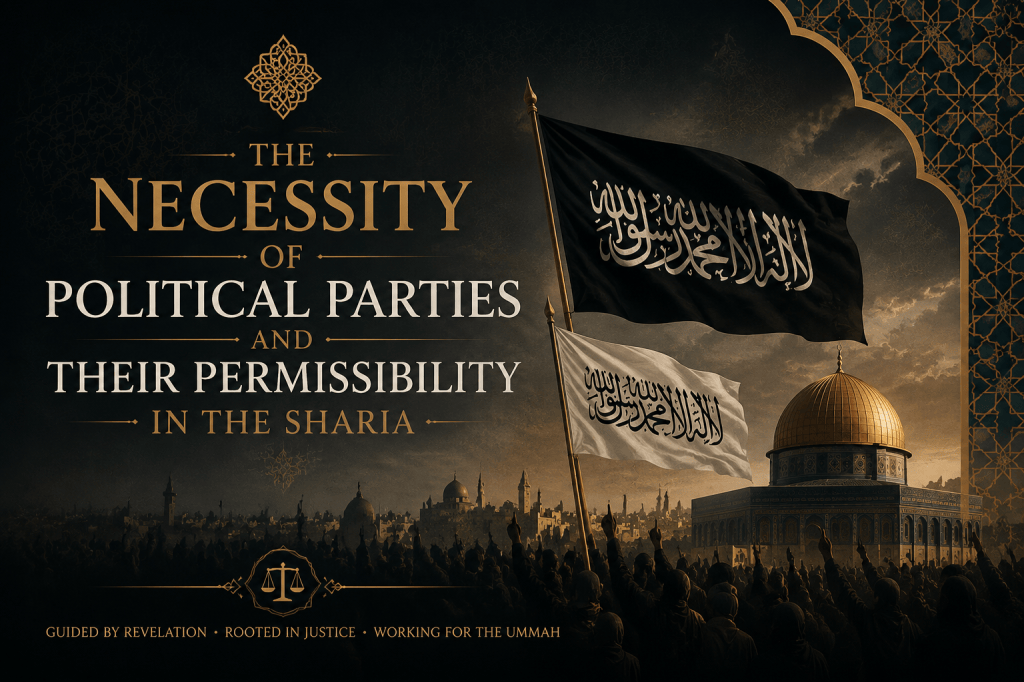
- Introduction
- Terms and Definitions
- The Default Ruling: Permissibility in Worldly Dealings
- Evidence from the Qurʾān
- Evidence from the Sunnah
- Evidence from Fiqh and Reason
- The Counter Arguments Answered One by One
- First objection: “Every party rejoicing in what it has”
- Second objection: “And do not become divided”
- Third objection: A borrowed Western principle and the prohibition of imitation
- Fourth objection: The absence of precedent among the Salaf
- Fifth objection: Party fanaticism and divided loyalty
- Sixth objection: The office of ḥisba is sufficient
- Seventh objection: The failure of the actual experiment
- The Conditions and Limits of Permissibility
- The Unity of the Ummah
Introduction
Wherever Muslims live today, the same question keeps returning. Is it lawful to build organised political structures, to join them, and to seek power through them? The question has long since left the seminar room and become a practical matter that shapes the political fate of the ummah. On one side stands a position that treats party formation as an innovation, sometimes as a disease that fractures the community. On the other stands a position that treats organised political work as the necessary instrument of enjoining good and forbidding wrong in this age. The distance between them looks like a minor juristic disagreement, and in its consequences it produces two entirely different visions of what the ummah should be.
The position argued here is that forming political parties and conducting political struggle through them is lawful in the Sharia, and that in present conditions it has risen to the level of a requirement, because there are obligations that cannot be discharged without this instrument. To establish that claim, this article first clarifies the terms, then identifies where the default ruling lies, then presents the evidence from the Qurʾān, the Sunna and legal theory, and finally takes up the objections one by one in their strongest form. Presenting the opposing view in a weakened shape would bury the question and settle nothing. For that reason the arguments of Ibn Bāz, al-Albānī and others appear here in their own words and at full strength.
Terms and Definitions
Ḥizb
The Arabic word derives from the root ح ز ب and denotes a body of people bound together by a shared cause. The Qurʾān uses it in both a condemning and a praising sense. Describing the believers, Allah says:
أُولَٰئِكَ حِزْبُ اللَّهِ ۚ أَلَا إِنَّ حِزْبَ اللَّهِ هُمُ الْمُفْلِحُونَ
“Those are the party of Allah. Truly, the party of Allah are the successful ones.”
The conclusion follows directly. The word ḥizb carries no prohibition in itself. Its value comes from the quality attached to it, so that the party ascribed to Allah attains success while the party ascribed to Satan meets ruin. Calling a structure a ḥizb therefore produces no legal ruling on its own.
The political party
In modern political literature, the political party is defined by François Goguel as an organised body that participates in political life with the aim of controlling power wholly or partly, in defence of the ideas and interests of its members. Three elements make up this definition: a structure that persists over time, a shared intellectual programme, and a claim on political power. None of these three contains anything the Sharia has forbidden.
Jamāʿa
The word means an assembled group. In Sharia usage it carries three distinct senses, and the confusion of these senses is where the debate becomes least productive. The first sense is the totality of the ummah. The second is the path upon which the ummah has agreed. The third is any organised body of people directed toward a defined aim. The texts warning against separation from the jamāʿa refer to the first two senses. Applying those texts to the third sense, so that every act of organisation becomes a departure from the ummah, moves the evidence away from its proper place.
Siyāsa
The Ḥanbalī jurist Abū al-Wafāʾ Ibn ʿAqīl gave a definition that holds the key to this whole discussion. He said, as transmitted by Ibn Qayyim al-Jawziyya in al-Ṭuruq al-Ḥukmiyya fī al-Siyāsa al-Sharʿiyya:
“Siyāsa is any action by which people come closer to what is sound and further from corruption, even if the Messenger, may Allah bless him and grant him peace, did not institute it and no revelation came down concerning it.”
What this definition establishes is that in the field of political instruments, the requirement is to remain within the boundaries drawn by the texts while realising benefit, without needing to locate a text for every administrative detail.
ʿAṣabiyya
The Prophet, may Allah bless him and grant him peace, defined this concept himself when asked about it. Wāthila ibn al-Asqaʿ, may Allah be pleased with him, reported that he asked the Messenger of Allah what ʿaṣabiyya was, and the Prophet replied:
“That you aid your people in wrongdoing.”
What the Sharia forbids here is aiding a group in injustice. Belonging to a group falls outside the scope of this prohibition.
The Default Ruling: Permissibility in Worldly Dealings
In the field of transactions and customs, the established juristic maxim is that the default in all things is permissibility. The practical consequence of this maxim concerns where the burden of proof sits. The party declaring an act forbidden must produce evidence, while the party affirming permissibility rests on the default ruling and owes no additional proof.
Yūsuf al-Qaraḍāwī placed the question on exactly this ground. He said, in his treatise on the plurality of parties under an Islamic state:
“There is no Sharia impediment to the existence of more than one political party within the Islamic state, because a Sharia prohibition requires a text, and there is no text.”
This redirects the entire discussion since those who declare party formation forbidden have no explicit text prohibiting the formation of a party, they must rest their case on inferences drawn from general verses. Those inferences are examined below one by one. Yet the point can be made at the outset that a probable inference drawn from a general verse cannot overturn the original ruling of permissibility.
In the same passage, al-Qaraḍāwī uses sharp language about fatwas that treat every form of organisation as innovation:
“This is a strange audacity toward the religion of Allah, an assault upon the Sharia without evidence, and a prohibition of what Allah has permitted without any authority. For the default in things and in the dealings connected with people’s customs and transactions is permissibility.”
Evidence from the Qurʾān
The command that an organised body exist
At the centre of the question stands verse 104 of Sūrat Āl ʿImrān:
وَلْتَكُن مِّنكُمْ أُمَّةٌ يَدْعُونَ إِلَى الْخَيْرِ وَيَأْمُرُونَ بِالْمَعْرُوفِ وَيَنْهَوْنَ عَنِ الْمُنكَرِ ۚ وَأُولَٰئِكَ هُمُ الْمُفْلِحُونَ
“Let there be from among you a body calling to the good, enjoining what is right and forbidding what is wrong. Those are the ones who will be successful.”
The word “وَلْتَكُن” comes in the imperative form and demands the existence of a body. Al-Qurṭubī addressed the grammar of the verse and drew out its legal consequence. He said, in al-Jāmiʿ li-Aḥkām al-Qurʾān:
“The particle min in His words ‘from among you’ indicates a portion, and its meaning is that those who enjoin must be scholars, for not all people are scholars. I say: the first opinion is more correct, for it indicates that enjoining good and forbidding wrong is an obligation of sufficiency.”
Two results emerge together. The first is that the existence of a specific body within the ummah charged with this duty is obligatory. The second is that because the duty is one of sufficiency, the manner in which that body comes into being has been left to the ijtihād of the ummah and stands unfixed by any text. The verse commands that a body exists and leaves its organisational form open.
Contemporary Islamic movements have read this verse as the charter of their own existence, and their reasoning rests on the same grammatical point. One of the clearest formulations of this reading comes from Hizb Ut Tahrir Al Islam, it states:
“Allah has ordered the Muslims in this verse that there must be among them a structured group which should perform two duties: firstly, to invite to the good, i.e. to invite to Islam; and secondly, to order what is right and forbid what is evil. This order to establish a structured group is a request. However, there is a conjunction to the effect that this is a decisive request.”
The command to cooperate in righteousness
وَتَعَاوَنُوا عَلَى الْبِرِّ وَالتَّقْوَىٰ وَلَا تَعَاوَنُوا عَلَى الْإِثْمِ وَالْعُدْوَانِ
“Cooperate with one another in righteousness and piety, and do not cooperate in sin and transgression.”
The word “تَعَاوَنُوا” comes in the sixth verbal form, which conveys reciprocal, sustained and regulated collaboration. Scattered individuals performing occasional good deeds do not fulfil the sense this form requires. The verse commands an institutionalised cooperation in the field of righteousness and leaves the legal shape of that cooperation unspecified. Under a modern state order, the principal shape available for such cooperation in the political field is the party.
The principle of shūrā
وَأَمْرُهُمْ شُورَىٰ بَيْنَهُمْ
“And their affair is by consultation among themselves.”
Consultation is described here as the manner in which believers conduct their collective affairs. For a society’s affairs to move by genuine consultation, there must be channels through which differing positions can be articulated in an orderly way, defended, and presented to the public. Where opinions cannot organise themselves, shūrā decays into a ruler consulting people of his own choosing and receiving the answer he wants. Parties supply the institutional form that makes consultation real.
The purpose of political power
الَّذِينَ إِن مَّكَّنَّاهُمْ فِي الْأَرْضِ أَقَامُوا الصَّلَاةَ وَآتَوُا الزَّكَاةَ وَأَمَرُوا بِالْمَعْرُوفِ وَنَهَوْا عَنِ الْمُنكَرِ
“Those who, if We establish them in the land, perform the prayer, give the zakāt, enjoin what is right and forbid what is wrong.”
The verse describes the purpose that political power ought to serve. Tamkīn, meaning the possession of strength and capacity in the land, is a condition the Qurʾān expects for the believers. The legitimacy of seeking power is settled by this verse, and the paths to that power change from age to age.
The description of the ranked line
إِنَّ اللَّهَ يُحِبُّ الَّذِينَ يُقَاتِلُونَ فِي سَبِيلِهِ صَفًّا كَأَنَّهُم بُنْيَانٌ مَّرْصُوصٌ
“Indeed Allah loves those who fight in His cause in ranks, as though they were a solid structure.”
Al-Qaraḍāwī cites this verse precisely in the discussion of organisation. Recalling that the forces hostile to Islam operate through large blocs and major collective institutions, he asks:
“How then shall we face them as scattered individuals, when the battle requires that everyone be packed together into a single line?”
Evidence from the Sunnah
The Pledge of ʿAqaba and the twelve naqībs
The clearest example of organisation in the Sunnah appears at the second Pledge of ʿAqaba. Once the pledge was complete, the Messenger of Allah ﷺ said to the Anṣār:
“Bring out to me from among you twelve chiefs, who will be responsible over their own people.”
Twelve representatives were selected, nine from the Khazraj and three from the Aws. The Prophet then took a further undertaking from those selected men, saying that just as the disciples stood as guarantors for ʿĪsā the son of Maryam, so they stood as guarantors over their own people, while he himself stood as guarantor over his.
The political character of this episode deserves attention. What we find is a covert political agreement, an elected delegation, defined spheres of responsibility, and a programme aimed at founding a state. All of these are the constituent elements of a political organisation. The first political organisation of the Ummah took shape before the state existed and for the purpose of bringing it into being. A view that treats organisation itself as an innovation encounters real difficulty in accounting for this passage of the sīrah.
The command to change what is wrong and the condition of capability
Abū Saʿīd al-Khudrī, may Allah be pleased with him, reported that the Messenger of Allah ﷺ said that whoever among us sees something wrong should change it with his hand, and if he is unable then with his tongue, and if he is unable then with his heart, and that this last is the weakest form of faith. The report is recorded by Muslim.
The first degree named in the hadith, changing a wrong by hand, requires power and standing. Within the structure of the modern state, it is impossible for a single individual to alter state policy by hand. For this degree to remain a live obligation, collective capacity must take the place of individual capacity.
Al-Qaraḍāwī formulates the point directly. Observing that correcting the deviation of a ruler can no longer be done by the sword, since all the swords are in the ruler’s possession, he writes that humanity has arrived after long struggle at a formula for enjoining good, forbidding wrong and correcting the crookedness of authority without bloodshed, and that this formula consists in the existence of organised political forces which the ruling power cannot easily eliminate. He then explains why such forces have this protective quality:
“Authority may overcome an individual or a small group of individuals by coercion or by cunning, but it finds it difficult to subdue large organised groups that have their extensions in society and their penetration among the people, and that possess their own platforms, newspapers and instruments of expression and influence.”
Believers as a mutually supporting structure
The Prophet ﷺ said that the believer is to the believer like a building whose parts support one another, as recorded by al-Bukhārī and Muslim. The image of a building describes something other than an accidental standing side by side. In a building, each stone occupies a determined position and carries a determined load. This is by definition a conception of organisation.
Evidence from Fiqh and Reason
The premise of an obligation
Among the most settled maxims of Fiqh is that whatever an obligation cannot be completed without becomes itself obligatory. Applied to our question, the chain runs as follows:
- Enjoining good and forbidding wrong is obligatory.
- Discharging this duty at the scale of the state requires organised political capacity.
- Therefore forming organised political capacity is obligatory.
Al-Qaraḍāwī states this maxim explicitly and draws its conclusion:
“Collective work to support Islam, to liberate its land, to unite its ummah and to raise its word is an obligation and a necessity. It is an obligation made binding by religion and a necessity imposed by reality, and collective work means forming groups or parties that carry out this duty.”
The pressure of present reality
The rational argument in its plainest form runs as follows: The modern state has accumulated power at a density unknown in earlier history. It shapes the educational curriculum, the media, the economy, the law and even the physical arrangement of cities from a single centre. Against a concentration of power at this density, the reforming effort of scattered individuals remains a well intentioned wish. Only an organised body can stand as a genuine counterpart to such a force.
The movements opposed to Islam grasped this fact long ago. Secular, nationalist and socialist programmes are carried everywhere in the world through parties, foundations, unions and research institutes. To ask Muslims alone to remain unorganised in this same field amounts to asking them to leave the ground empty.
The Counter Arguments Answered One by One
Up to this point the affirmative evidence has been set out. We now turn to the other face of the question. The evidence of the scholars who reject party formation is serious, and part of it identifies a genuine danger. Presenting it in a softened form would fall short of an honest treatment.
First objection: “Every party rejoicing in what it has”
The most frequently cited evidence consists of these verses from Sūrat al-Rūm:
وَلَا تَكُونُوا مِنَ الْمُشْرِكِينَ مِنَ الَّذِينَ فَرَّقُوا دِينَهُمْ وَكَانُوا شِيَعًا ۖ كُلُّ حِزْبٍ بِمَا لَدَيْهِمْ فَرِحُونَ
“And do not be among those who associate partners with Allah, among those who split up their religion and became sects, every party rejoicing in what it has.”
The objection holds that the verse condemns party formation outright and presents it as a characteristic of the idolaters.
The answer: The wording of the verse states the ground of the censure openly, namely that they split up their religion. What is condemned is disagreement in the religion itself and fragmentation within it. Ibn Kathīr made this explicit. He said, in Tafsīr al-Qurʾān al-ʿAẓīm:
“Meaning: do not be among the idolaters who split up their religion, that is, they exchanged it and altered it, and believed in part of it and disbelieved in part. These are like the Jews, the Christians, the Magians, the idol worshippers and all the remaining adherents of false religions apart from the people of Islam.”
ʿAbd al-Raḥmān al-Saʿdī pressed the same point in his commentary. He said, in Taysīr al-Karīm al-Raḥmān:
“‘Among those who split up their religion’ although the religion is one, namely devoting worship purely to Allah alone, and these idolaters split it up. ‘And became sects’ meaning that every faction of the factions of idolatry gathered itself together and became partisan in supporting the falsehood it possessed, and in rejecting and fighting the others.”
Al-Wāḥidī and al-Baghawī read the term in the same way, taking the ḥizb in this verse to mean each group among those who abandoned their religion.
The conclusion is plain: The verse condemns division in creed and in the foundations of the religion. Bodies that agree upon a single religion, that hold no disagreement in creed or in the definitive rulings of the Sharia, and that differ only in political programme and administrative method, fall outside its scope. Beyond this, we have already seen that the same word ḥizb is used in the Qurʾān for the believers. That the identical word is censured in one place and praised in another shows that the ruling attaches to the quality ascribed to the word, while the word by itself carries none.
Second objection: “And do not become divided”
وَاعْتَصِمُوا بِحَبْلِ اللَّهِ جَمِيعًا وَلَا تَفَرَّقُوا
“And hold fast, all of you together, to the rope of Allah, and do not become divided.”
The objection holds that plurality contradicts the unity the verse commands.
The answer: This objection loses sight of the distinction between plurality and fragmentation. Disagreement comes in two kinds. The first is the disagreement of variety, which arises from differing ijtihād and displays different faces of a single truth. The second is the disagreement of contradiction, which negates the other side and generates enmity. The first grants the ummah breadth and stands free of censure, while the second is what the verse prohibits.
Al-Qaraḍāwī draws this distinction and then attaches a condition to it. He said:
“Not every disagreement is evil. Disagreement is of two kinds: the disagreement of variety and the disagreement of contradiction, the first being praiseworthy and the second blameworthy.”
He then specifies what makes plurality acceptable, requiring that it be a plurality of variety and specialisation free of collision and contradiction, with everyone standing in a single line on all the decisive questions touching the Islamic existence, the Islamic creed, the Islamic Sharia and the Islamic ummah.
The Companions, may Allah be pleased with them, disagreed extensively in secondary matters and this disagreement caused them no harm. For centuries the ummah organised itself around four schools of law, founded colleges and developed distinct methodologies, and no scholar treated this as a violation of Āl ʿImrān 103. Al-Qaraḍāwī establishes the parallel openly:
“The plurality of parties in the field of politics resembles nothing so much as the plurality of the schools of law in the field of jurisprudence.”
Third objection: A borrowed Western principle and the prohibition of imitation
The objection runs as follows: Party formation and the multi party system are products of Western democracy, they did not arise from Islam, and we have been commanded to avoid resembling the disbelievers.
The strongest statement of this objection comes from Nāṣir ibn Sulaymān al-ʿUmar. He said, in his article on forming parties and participating in elections:
“Democracy is a Western commodity in its source and in its content, and it contradicts definitive Sharia rulings by making the right of legislation guaranteed to the people or to their representatives.”
This objection deserves to be taken seriously, since it touches the question of sovereignty belonging to Allah.
The answer: The imitation that has been forbidden is resembling a people in the marks of their religious distinctiveness in a way that assimilates a person into them. Benefiting from them in the developing affairs of worldly life falls outside that prohibition, and the evidence for this in the Sunnah is clear. Al-Qaraḍāwī gathers these precedents together. He said, in his treatise on Islam and democracy:
“There is nothing in the Sharia that prevents the adoption of a theoretical idea or a practical solution from non Muslims. The Prophet ﷺ adopted the idea of digging the trench in the Battle of the Confederates, and that was among the methods of the Persians. Wisdom is the lost property of the believer; wherever he finds it, he has the greatest right to it.”
To this may be added that the Prophet ﷺ took a seal for his letters once he was informed that kings accepted no letter unless it bore a seal, and that ʿUmar ibn al-Khaṭṭāb, may Allah be pleased with him, drew on Persian administrative experience when he established the dīwān. None of this was counted as forbidden imitation.
Al-Qaraḍāwī sets two conditions on such borrowing, the first being that we find a genuine benefit in it for ourselves, and the second being that we modify and develop what we adopt until it accords with our religious values, our moral ideals, our Sharia rulings and our observed traditions.
The second condition answers the real force of the objection. The legislative philosophy of democracy and the mechanism of party organisation are separable things. The philosophy that grants the people authority to permit what Allah has forbidden and forbid what He has permitted is rejected. The mechanism that allows a society to hold its ruler account and to replace him without bloodshed when necessary is adopted and rebuilt according to the boundaries of the Sharia.
It is worth noting that al-ʿUmar himself, for all the severity of his objection, permits political participation under specified conditions. He said, at the close of the same article:
“These are a set of conditions. If they are met, we hold that participation is permitted in order to realise a higher benefit and to repel a greater harm.”
This shows that even among the sternest representatives of the opposing camp, the question is not held at the level of absolute prohibition.
Fourth objection: The absence of precedent among the Salaf
The objection holds that the Companions and the Successors formed no parties, and that the practice is therefore something newly invented.
The answer: This reasoning treats the mere fact of omission as evidence of prohibition. An omission by the Salaf serves as evidence only where the cause requiring the act was present and the act was nevertheless left undone. Where the cause arose later, the omission carries no evidential weight.
The Salaf formed no parties because they faced no modern bureaucratic state, no mass communication, no constitutional order, no electoral systems and no organised ideological movements. That same Salaf established no dīwān until ʿUmar, may Allah be pleased with him, established one. They did not reproduce the Muṣḥaf in a single standard copy until ʿUthmān, may Allah be pleased with him, did so. They did not codify the science of grammar until corruption in the language began to appear. None of these firsts was counted as an innovation, because each of them arose in the field of means and in response to a need that had come into being.
Beyond this, the nucleus of organisation is present in the Pledge of ʿAqaba discussed above. The selection of twelve chiefs, the distribution of spheres of responsibility and the covert political agreement aimed at founding a state belong in principle to the same category as party formation.
Fifth objection: Party fanaticism and divided loyalty
This is the strongest of the objections and it identifies a real disease. The claim is that a party member gradually turns his party into the measure of truth, defends it whether it is right or wrong, treats those outside it as having strayed from the religion, and thereby builds his loyalty and disavowal around the party in place of the religion.
On the diagnosis of this danger, the words of ʿAbd al-ʿAzīz ibn Bāz are unambiguous. Asked about affiliation with newly formed parties, he said, in a fatwa recorded in his collected fatwas and articles:
“As for affiliations with newly invented parties, what is obligatory is to abandon them, and that all should affiliate themselves with the Book of Allah and the Sunnah of His Messenger ﷺ and that they cooperate in that with truthfulness and sincerity. By that they become part of the party of Allah.”
In the same fatwa he sets down a principle that no party may transgress, stating that partisanship for any association or party is impermissible in whatever contradicts the pure Sharia, and that in this respect no distinction exists between the Muslim Brotherhood, Anṣār al-Sunna, al-Jamʿiyya al-Sharʿiyya, Jamāʿat al-Tablīgh or any other association or party ascribing itself to Islam.
Muḥammad Nāṣir al-Dīn al-Albānī reached a more categorical ruling. Asked about the multiplicity of groups and parties, he said:
“There are no parties in Islam, meaning that it is not legislated in Islam for there to be parties, and there ought not to be parties among the Muslims.”
The answer:Two things must be said here.
The first is that the disease this objection identifies is real and nothing about it can be denied. A body that puts itself in the place of the whole ummah, that declares its opponents astray and attributes infallibility to its leader does the ummah harm.
Al-Qaraḍāwī condemns this deviation openly within the very passage where he permits party formation. Writing about groups that style themselves “the community of the Muslims” while being one community among the Muslims, and that treat everyone who leaves them as having left the jamāʿa, he says:
“This kind of reasoning, and the application of the texts to something other than what they came for, is a door of evil upon the ummah, because it places the evidences somewhere other than their proper places.”
The second point, and the more important one, is that this objection targets a disease that attaches to the party from outside and leaves its essence untouched. In fiqh, the fact that something is open to misuse fails to establish that the thing is forbidden in itself. The scholar who draws this distinction most sharply is Ibn Taymiyya, who himself took the hardest line against fanaticism. He said, in Iqtiḍāʾ al-Ṣirāṭ al-Mustaqīm, discussing the partisanship of the age of ignorance:
“What is to be guarded against in this is only a man’s unqualified partisanship for his own faction upon the basis of the age of ignorance. As for supporting it with the truth and without transgression, that is good, obligatory or recommended.”
This statement sits at the very heart of the matter. Ibn Taymiyya has forbidden neither belonging to a body nor supporting it. What he forbids is that the support be unqualified and extend to covering wrongdoing. Support given upon the truth and without transgression stands at the level of the obligatory or the recommended. The hadith of Wāthila cited earlier draws the same boundary, defining ʿaṣabiyya as aiding one’s people in wrongdoing.
The chain of transmission of the most famous narration condemning ʿaṣabiyya supports this careful reading. The report of Jubayr ibn Muṭʿim, may Allah be pleased with him, that “he is not of us who calls to ʿaṣabiyya” carries a weak isnād in Abū Dāwūd owing to Muḥammad ibn ʿAbd al-Raḥmān ibn Abī Labība. Its meaning is nevertheless established through the narration of Abū Hurayra in Muslim, where the censure is attached to fighting under a blind banner and to becoming enraged for the sake of partisanship. What is condemned, in other words, is attaching oneself to a side without regard for the truth.
Ibn Taymiyya’s celebrated measure concerning fanaticism completes the boundary. He said, in Majmūʿ al-Fatāwā:
“It is not for anyone to set up for the ummah a person who calls to his own way, upon whom loyalty and enmity are based, other than the Prophet, may Allah bless him and grant him peace. Nor may he set up for them any speech upon which loyalty and enmity are based, other than the speech of Allah and His Messenger and that upon which the ummah has agreed. Rather this is the practice of the people of innovation, who set up for themselves a person or a statement by which they divide the ummah.”
This measure fixes the Sharia limit of party organisation and leaves the organisation itself standing. The standard of loyalty and disavowal remains permanently the Book and the Sunna. The party continues to exist as an instrument, and the moment it attempts to become the standard, its ruling changes.
Sixth objection: The office of ḥisba is sufficient
Some opponents raise the following objection: the institution of ḥisba is sufficient for holding the ruler to account, and no party is needed beyond it.
The answer: Historically the office of ḥisba was a supervisory mechanism the state established within itself, and the muḥtasib was appointed by the ruler. For a ruler to audit his own injustice through an officer he has himself appointed contradicts the very logic of supervision.
Al-Qaraḍāwī’s observation quoted earlier applies here directly, that supervision comes about only where an independent force exists which the ruling power cannot easily eliminate. Ḥisba functions well for removing wrongs within society. Calling the ruling power itself to account requires a body that stands outside that power and possesses resources independent of it.
Seventh objection: The failure of the actual experiment
Finally it is said that the experiment of party formation has ended in disappointment across the Muslim world, that Islamic movements have split, that cadres have been worn down and that no result has been achieved.
The answer: This reasoning confuses the ruling with the outcome. That an instrument fails under particular conditions leaves its Sharia ruling untouched. Victory came at Badr and defeat at Uḥud, and nobody took the defeat as grounds for reopening the ruling on jihād. Failure calls for a review of the practice.
Hasan al-Bannā’s opposition to party politics in his own time is also frequently cited as evidence. Al-Qaraḍāwī answers this too, characterising al-Bannā’s stance as an act of ijtihād. He said:
“That was an ijtihād of his, because of the party politics he witnessed in his time which divided the ummah before its enemy, parties that had gathered around persons, without clear aims or defined programmes. The fatwa changes with the change of time, place and circumstance, and especially in matters of politics, which change a great deal.”
The Conditions and Limits of Permissibility
Granting permissibility in this question falls short of declaring an unlimited freedom. A Sharia permission always arrives with its conditions attached, and these conditions show how serious the matter is.
Al-Qaraḍāwī sets two fundamental conditions for parties to acquire legitimacy. He said:
“All that is required for these parties to acquire the legitimacy of their existence are two fundamental matters: that they acknowledge Islam as creed and Sharia and do not show enmity toward it or repudiate it, even if they hold their own ijtihād in understanding it in the light of the established scholarly principles; and that they do not work on behalf of any quarter hostile to Islam and its ummah, whatever its name and position.”
He then draws the natural consequence of these conditions, stating that it is impermissible for a party to be founded which calls to atheism, licentiousness or irreligion, or which attacks the revealed religions generally or Islam in particular, or which belittles the sanctities of Islam, whether its creed, its Sharia, its Qurʾān or its Prophet.
The IslamWeb fatwa centre draws the same distinction. It states, regarding the establishment of parties in Muslim lands:
“Parties that are not founded upon Islam and do not call to it, such as secular, communist, socialist and nationalist parties and the like, it is impermissible to establish them or to enable them, because of the cooperation in sin and transgression that this involves and the confirmation of the falsehood they stand upon.”
Its English language fatwa formulates the affirmative side of the same principle:
“But if the party is established on the truth and justice, while holding fast to the Book of Allaah, the Sunnah of the Prophet and to the guidance of our pious predecessors and strives to benefit the people and support the truth, then cooperating with such a group is a religious obligation.”
The Egyptian Dār al-Iftāʾ reached a similar position in a statement issued in response to fatwas declaring political parties forbidden, affirming the permissibility of political and party plurality and pointing to evidence within Islamic jurisprudence that supports it.
Alongside these conditions, the internal limit identified above through Ibn Bāz and Ibn Taymiyya retains its force. A party cannot substitute its own membership for the whole of the ummah, cannot treat its own ijtihād as the religion itself, and cannot regard the difference between itself and its opponents as the difference between belief and unbelief.
The Unity of the Ummah
The preceding sections have established the legitimacy and the necessity of organisation. We now come to the actual purpose of this article, namely the end that all of this work is meant to serve. Political organisation is an instrument and constitutes no aim in itself, and the aim it serves is the unity of the ummah.
Unity is a definitive command of Allah, standing well beyond a fine quality Muslims might wish for. Our Lord says:
وَاعْتَصِمُوا بِحَبْلِ اللَّهِ جَمِيعًا وَلَا تَفَرَّقُوا وَاذْكُرُوا نِعْمَتَ اللَّهِ عَلَيْكُمْ إِذْ كُنتُمْ أَعْدَاءً فَأَلَّفَ بَيْنَ قُلُوبِكُمْ فَأَصْبَحْتُم بِنِعْمَتِهِ إِخْوَانًا
“And hold fast, all of you together, to the rope of Allah, and do not become divided. Remember the favour of Allah upon you: you were enemies and He joined your hearts together, so that by His favour you became brothers.”
The words lā tafarraqū come in the prohibitive form, and in fiqh a prohibition indicates unlawfulness as its default sense. Division therefore falls within the category of sin. The recollection of unity as a favour in the same verse also deserves attention. The blood feud between the Aws and the Khazraj had run for generations, and faith joined those hearts together. Unity is a gift Allah bestowed upon the believers, and ingratitude toward a gift is the way to lose it.
The oneness of the ummah is a divine attribute, fixed beyond the reach of the ummah’s preference:
إِنَّ هَٰذِهِ أُمَّتُكُمْ أُمَّةً وَاحِدَةً وَأَنَا رَبُّكُمْ فَاعْبُدُونِ
“Truly this ummah of yours is one single umma, and I am your Lord, so worship Me.”
Allah has described the ummah as one. Every attitude that breaks this description sets itself against a divine ruling. Brotherhood is established with the same finality:
إِنَّمَا الْمُؤْمِنُونَ إِخْوَةٌ فَأَصْلِحُوا بَيْنَ أَخَوَيْكُمْ
“The believers are but brothers, so set matters right between your brothers.”
The cost of division is stated concretely in the Qurʾān:
وَأَطِيعُوا اللَّهَ وَرَسُولَهُ وَلَا تَنَازَعُوا فَتَفْشَلُوا وَتَذْهَبَ رِيحُكُمْ وَاصْبِرُوا
“And obey Allah and His Messenger, and do not dispute with one another, lest you lose heart and your strength depart. And be patient.”
The verse names two consequences of dispute: fashal, the weakening of resolve, and the departure of the rīḥ, the loss of force and standing. Reading the present condition of the ummah in the light of this verse makes the diagnosis easier. The number of Muslims has not fallen, their resources have not run dry, their lands have not shrunk. What has been lost is the rīḥ named in that verse, the collective weight that dissipates through dispersion.
The Sunnah conveys the same truth in more concrete language. The Prophet ﷺ said that the believers in their mutual love, mercy and affection are like a single body, and that when one limb of it complains, the rest of the body joins it in sleeplessness and fever, as recorded by al-Bukhārī and Muslim. A body in which one limb feels no pain from another is showing a sign of paralysis. A community of Muslims that watches events in Palestine, East Turkestan, Arakan or Sudan as though they were distant news is describing something other than the healthy body of this hadith.
The protective quality of remaining with the community is likewise stated plainly. ʿUmar ibn al-Khaṭṭāb, may Allah be pleased with him, in his well known sermon at al-Jābiya, transmitted from the Prophet ﷺ that we must hold to the community and beware of division, for Satan is with the one who is alone and stands further from two, and that whoever desires the centre of Paradise should hold to the community. Al-Tirmidhī graded this report ḥasan ṣaḥīḥ gharīb through this chain.
Wa’Allāhu Aʿlam
Sayf Al-Furqan Publications
About UsSayf Al-Furqan PublicationsAuthorCaliphate Defence ForceTiktok; Caliphate Defence ForceInstagram;Caliphate Defence ForceYoutube; Iftira Tarih Utansin | Twitter;Talha Ibn YusufUpscrolled; Caliphate Defence ForceScribd;Caliphate Defence ForceWebsite; Hayatimanvecihad8Cdfnews7 |



Bir Cevap Yazın