
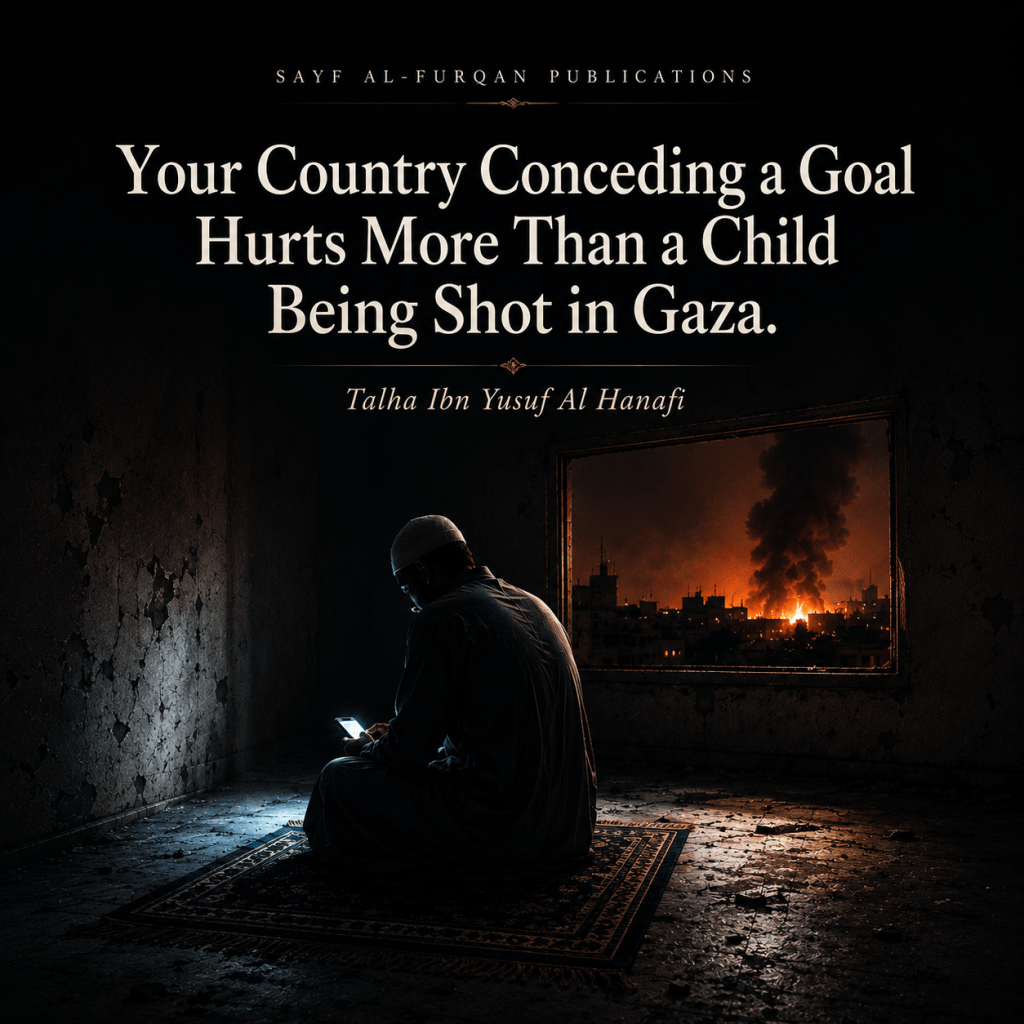
There is a particular kind of pain that the Muslim heart feels when the national football team concedes a goal. Hands go to heads. Men who have not prayed Fajr in years suddenly shout at the sky. Group chats explode. The emotion is raw, immediate, and unfiltered. Now ask yourself when you last felt something like that for Gaza. When a child had their skull opened by a Zionist sniper. When a mother was pulled from rubble that used to be her home. If the honest answer is that the football match moved you more, then this article is written for you, and it is written with concern, not contempt.
This is a question of īmān. There is no way around that word.
Emotions are not neutral. They are shaped by what we love, what we fear, and what we have been conditioned to consider our own. The Muslim who weeps for a goal and feels nothing for a dead child in Gaza has a heart that has been trained. Trained by years of sports broadcasts, national pride, tribal belonging, and a culture that treats football as high stakes and Muslim blood as background noise.
The problem is not that you care about football. The problem is the hierarchy. When a Muslim child dies and you scroll past it, but a match result keeps you up at night, your emotional hierarchy has been inverted. What the dunya offers has climbed above what Allah made sacred.
The Prophet, peace be upon him, named this disease directly. He said:
“The people will soon summon one another to attack you as people when eating invite others to share their dish… No, you will be numerous at that time: but you will be scum and rubbish like that carried down by a torrent, and Allah will take fear of you from the breasts of your enemy and cast enervation into your hearts.” When the companions asked what wahn was, he replied: “Love of the world and dislike of death.” (Sunan Abī Dāwūd, 4297)
Wahn is the reordering of what matters. When the dunya, its entertainment, its results, its temporary victories, sits higher in your chest than the pain of your brothers and sisters, that is wahn. And the Prophet, peace be upon him, told us it was coming.
He also left us the test by which we can measure where we stand. He said:
“The believers, in their mutual love, compassion, and sympathy, are like a single body; if one of its organs suffers, the whole body will respond with sleeplessness and fever.” (Ṣaḥīḥ al-Bukhārī 6011; Ṣaḥīḥ Muslim 2586)
The nerve is cut. The body is no longer functioning as it was built to function. A child in Gaza with a bullet in their skull is a limb of the body. The body’s response is not a trending hashtag and then a return to the match. The body’s response is sleeplessness. Fever. Sustained, physical, involuntary pain.
Ask yourself honestly: does that describe you? Or does the child in Gaza produce in you what a footnote produces, a passing acknowledgement, and then you move on?
This emotional disconnection is not a personal failure alone. It is a symptom of a Ummah that has been fragmented for over a century, a Ummah with no single body that can translate the pain of one limb into the action of the whole. Allah commanded:
وَاعْتَصِمُوا بِحَبْلِ اللَّهِ جَمِيعًا وَلَا تَفَرَّقُوا
“And hold firmly to the rope of Allah all together and do not become divided.” (Sūrat Āl ʿImrān, 3:103)
And He declared the nature of that bond with no ambiguity:
إِنَّمَا الْمُؤْمِنُونَ إِخْوَةٌ
“The believers are but brothers.” (Sūrat al-Ḥujurāt, 49:10) [4]
Not neighbors, not fellow citizens of a shared geography. Brothers. The child in Gaza is not a distant tragedy. He is your child. And you felt more when your team conceded.
The restoration of that feeling, the rewiring of the Muslim heart back to its proper hierarchy, requires more than reminders and articles. It requires a unified Ummah with a single authority that treats the blood of every Muslim as equally inviolable and responds to it institutionally, militarily, and politically. Imam al-Māwardī stated in al-Aḥkām al-Sulṭāniyyah that the establishment of the Imāmah is an obligation by consensus of the scholars. The Khilāfah is the institutional body through which the pain of one limb becomes the response of the whole. Without it, every Muslim is left to feel, scroll, and forget alone.
Work for its return through da’wah and the seeking of nuṣra. And in the meantime, discipline the heart. When you hear of a child shot in Gaza, sit with it. Do not move on. Let it cost you something. That cost is the minimum the Prophet, peace be upon him, described when he said the body responds with sleeplessness and fever.
Gaza is in fever. The question is whether the rest of the body will wake.
Sayf Al-Furqan Publications
About UsSayf Al-Furqan PublicationsAuthorCaliphate Defence ForceTiktok; Caliphate Defence ForceInstagram;Caliphate Defence ForceYoutube; Iftira Tarih Utansin | Twitter;Talha Ibn YusufUpscrolled; Caliphate Defence ForceScribd;Caliphate Defence ForceWebsite; Hayatimanvecihad8Cdfnews7 |



Bir Cevap Yazın