
 | Analysis of Drug Contamination in Gaza Aid and Associated Violations of International Law | Editted by Talha Ibn Yusuf 4 Muharram 1447 |
Go to the PDF for the sources;
Executive Summary
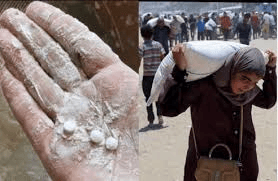
This article examines the grave allegations made by Gaza authorities regarding the discovery of Oxycodone pills in US-dispatched flour bags intended as humanitarian aid.
The incident, reported on June 27, 2025, raises profound concerns about public health, the integrity of humanitarian assistance, and potential violations of international law. The deliberate contamination of a staple food with a highly addictive opioid presents an unprecedented public health catastrophe, particularly for a population already facing severe malnutrition and a collapsed healthcare system.
If it’s proven true, this act would completely destroy any remaining trust in humanitarian aid. It looks like a strategic move to tear Palestinian society apart from the inside, and it could easily be considered a war crime on multiple levels—using poison and starvation as weapons.
This incident doesn’t happen in a vacuum. It’s part of a much bigger pattern of war crimes by Israel in Palestine. This includes deliberately targeting civilians, destroying buildings and essential services, blocking aid, and committing gender-based violence, all of which have been documented by numerous international organizations and human rights groups. The combined effect of these actions is a massive, long-term threat to the well-being and future of the Palestinian people.
1. Introduction: The Drug Discovery in Gaza Aid
1.1 Overview of the Incident and Claims by Gaza Authorities
On June 27, 2025, the Gaza government media office issued a stark condemnation following the reported discovery of opioid pills, specifically identified as Oxycodone, within flour bags distributed as part of US-backed aid. This alarming claim has garnered significant attention across various media outlets, including Middle East Eye, Anadolu Agency, Daily Sabah, and The Economic Times.
Authorities in Gaza stated they had collected and documented four testimonies from citizens who found these pills inside the flour bags, providing initial support for their allegations.
A particularly serious concern articulated by the Gaza government media office is the “possibility that some of these narcotic substances were deliberately ground or dissolved in the flour itself”.
This potential method of contamination would represent a direct and widespread “assault on public health,” given the ubiquitous consumption of flour as a staple food within the besieged enclave. In their official statements, Gaza authorities explicitly held Israel “fully responsible for this ‘heinous crime’ aimed at spreading addiction and destroying the Palestinian social fabric from within”.They further characterized this act as “a part of the ongoing Israeli genocide against the Palestinians,” describing Israel’s purported use of drugs in this manner as a “soft weapon in a dirty war against civilians”.
1.2 Context of Humanitarian Aid Distribution in Gaza
This incident happened under the watch of a new aid system called the Gaza Humanitarian Foundation (GHF), which is said to be backed by the US and run by the Israeli military. This is a big change from how aid used to be distributed..
This detail is critical because it highlights the exact way the contamination reportedly happened.
The GHF commenced operations in May 2025, following Israel’s announcement of a partial lifting of a three-month blockade on humanitarian assistance. However, this Israeli-established mechanism has been widely opposed by the international community and the United Nations, which view it as an attempt by Israel to circumvent established UN channels for aid distribution.
Humanitarian organizations and UN agencies have voiced strong opposition and refused to cooperate with the GHF, often labeling it a “death trap” for Palestinians and accusing it of facilitating Israel’s “genocidal war on Gaza“.
This existing environment of distrust and concern regarding the GHF’s operations precedes the current allegations.
The UNRWA Commissioner-General, Philippe Lazzarini, explicitly described the new aid distribution system as a “killing field,” reporting that over 400 starving people had been killed while attempting to access food since its inception, with testimonies indicating indiscriminate firing by soldiers.
Gaza’s Health Ministry backs up these horrifying numbers, reporting that over 549 Palestinians have been killed and 4,000 wounded by Israeli fire near aid centers and UN food truck locations since May 27.
To make matters worse, the Israeli newspaper Haaretz reported that Israeli Defence Forces (IDF) soldiers were actually ordered to shoot at unarmed Palestinians who were just trying to get aid at these GHF distribution points. One soldier even called his post a “killing field.”
The discovery of drugs in aid is particularly disturbing, especially when it’s happening within an aid system that’s already so messed up.
Gaza authorities have been saying for a while now that Israel is “exploiting the blockade to weaponize humanitarian aid” and using drugs as a “soft weapon.”² This suggests that the contamination isn’t just some random smuggling operation—it’s a deliberate, calculated move to actively undermine humanitarian efforts.
If it’s confirmed, this act of putting dangerous, addictive drugs into essential food supplies would turn humanitarian aid from a neutral lifeline into a tool for harm and control. It’s a calculated strategy to inflict suffering and destabilize the population while pretending to help them. This goes way beyond simply blocking aid; it’s actively sabotaging it.
On top of all that, this incident would have a huge impact on the credibility and effectiveness of all humanitarian groups. The trust issues already present in Gaza, made worse by Israeli restrictions and the controversial Gaza Humanitarian Foundation (GHF), would be magnified tenfold. If people fear that their food is poisoned, they might refuse aid altogether, even if they’re starving. This would make the humanitarian crisis even worse, creating a self-inflicted barrier to aid. It could even be a secondary, strategic goal to further destabilize the population and control their access to resources, making them even more desperate and dependent.
2. Oxycodone: Properties, Dangers, and Health Impacts
2.1 Nature and Chemical Composition of Oxycodone
Oxycodone is scientifically classified as a semisynthetic opioid, derived from thebaine, a naturally occurring opium alkaloid. Its molecular formula is C18H21NO4.
Chemically, oxycodone hydrochloride is described as a white, crystalline, odorless powder that is readily soluble in water.
This solubility is particularly significant in the context of the allegations, as Gaza authorities warned of the “possibility that these narcotic substances were deliberately ground or dissolved in the flour itself“.
2.2 Therapeutic Uses and Risks of Misuse/Abuse
In legitimate medical contexts, Oxycodone is a potent opioid analgesic used for the relief of moderate to severe pain, often prescribed for severe and long-term pain conditions, including those experienced by cancer patients. Its mechanism of action involves stimulating mu-, kappa-, and delta-type opioid receptors in the central nervous system (CNS), which inhibits ascending pain pathways and produces generalized CNS depression.
While Oxycodone does have therapeutic value, it’s also well known for its high potential for addiction. Even when used as prescribed and monitored by a doctor, there’s still a significant risk of developing physical dependence. Over time, this can lead to what’s clinically known as Opioid Use Disorder — a serious condition that affects both the body and mind. People who misuse Oxycodone can quickly develop a tolerance, meaning they need higher and higher doses just to feel the same effects. If they suddenly stop taking it, they may experience intense and often very uncomfortable withdrawal symptoms, both physically and emotionally.
2.3 Acute and Chronic Health Consequences of Opioid Exposure
Exposure to Oxycodone, especially in high or uncontrolled doses, can be extremely dangerous and even life-threatening. An overdose can cause symptoms like extreme drowsiness, muscle weakness, confusion, cold and clammy skin, pinpoint pupils, slowed breathing, a dangerously low heart rate, fainting, and even coma or death — mainly because it can severely depress the respiratory system. In some cases, people may also experience hallucinations as an acute effect.
Long-term or chronic use of Oxycodone can lead to extensive and serious damage across multiple organ systems and overall health, especially if misuse or addiction develops. This includes:
- Liver Damage: Prolonged use, particularly when Oxycodone is combined with acetaminophen (a common ingredient in many prescription opioid formulations), can cause severe liver damage, including hepatitis or liver failure.
- Kidney Damage: Long-term opioid use can impair kidney function by reducing blood flow and contributing to dehydration, potentially leading to chronic kidney disease or acute kidney injury.
- Endocrine Disruption: Opioids can significantly disrupt the body’s hormonal balance, notably by suppressing the production of sex hormones like testosterone and estrogen. This can result in opioid-induced hypogonadism, leading to symptoms such as reduced libido, infertility, menstrual irregularities in women, bone loss (osteoporosis), decreased muscle mass, and depression.
- Weakened Immune System: Chronic opioid use has been linked to a suppressed immune response, increasing an individual’s susceptibility to various infections, including respiratory and skin infections.
- Cardiovascular Problems: Long-term use can lead to cardiovascular issues, including an increased risk of heart attack and heart failure, as well as blood pressure fluctuations and irregular heart rhythms.
- Respiratory Problems: Beyond acute respiratory depression, chronic opioid use can lead to long-term reduction in lung function and increased risk of respiratory illnesses.
- Brain Changes: Chronic opioid use can alter the structure and function of the brain, making it difficult for individuals to experience pleasure naturally and potentially leading to cognitive decline.
- Gastrointestinal Issues: Constipation is an extremely common and often severe side effect of opioid use, resulting from slowed digestive system motility.
2.4 Specific Vulnerabilities and Effects on Children
Children are especially vulnerable when it comes to opioid exposure. Even small amounts can affect them more strongly than adults. Some of the common side effects seen in children include drowsiness, itching, nausea, vomiting, and dizziness. They might also describe feeling “loopy” or “fuzzy,” which reflects how these drugs can alter their mental state in ways that are confusing or unsettling for them.
Signs of an opioid overdose in children are critical and require immediate medical attention. These include a pale or clammy face, small constricted “pin-point” pupils, a limp body, blue or purple fingernails or lips, gurgling noises or vomiting, difficulty to wake or inability to speak, and slowed or stopped breathing or heartbeat. Withdrawal symptoms in children, if exposure is prolonged and then stopped, can manifest as flu-like symptoms (sweating, chills, aches), fatigue, anxiety, trouble sleeping, rapid heart rate, headache, nausea, vomiting, and diarrhea. Although addiction and breathing issues are rare when Oxycodone is given properly under close medical supervision, the situation becomes far more dangerous when exposure is involuntary, uncontrolled, and potentially widespread — especially for children. In these cases, the risks increase significantly and can lead to serious, even life-threatening outcomes.
Exposing a war-torn, severely malnourished population — especially children — to a highly addictive opioid like Oxycodone, without their knowledge or consent, is more than just a health risk. It’s a public health emergency on a scale we’ve rarely, ever, seen.
This goes far beyond typical drug abuse situations. Medical research is clear about how addictive Oxycodone is and how serious both its short- and long-term effects can be.
Now imagine those risks stacked on top of an already devastated population, where 96% of Gaza’s one million children are malnourished, and 60,000 kids under five are suffering from acute malnutrition. The consequences could be catastrophic. , and a healthcare system described as “collapsed” and “critically under-resourced“.
Introducing a substance like this into a basic food source such as flour means people would be exposed without ever knowing and without any way to avoid it.
It removes any element of personal choice or medical supervision. In a population already struggling with hunger, trauma, and poor health, the effects of such exposure would be devastating. The drug’s physical and psychological impacts would hit harder and faster, leading to widespread addiction and rapid health decline, all in a place where the healthcare system is barely functioning, if at all. Children, who are already suffering the most from this conflict and are especially sensitive to opioids, could face long-term developmental and health consequences, including cognitive damage and addiction. This wouldn’t just deepen today’s crisis, but could cripple the future of an entire generation.
This drug contamination introduces a deeply troubling and insidious new layer to an already unbearable humanitarian crisis, making any path toward recovery far more difficult and threatening to entrench long-term societal dependency and suffering.
Gaza is already gripped by what has been described as “apocalyptic humanitarian conditions”, a reality marked by famine, the large-scale destruction of essential infrastructure, and a health system that is barely functioning.
In this fragile context, the spread of opioid addiction would introduce a devastating new layer of suffering. The health burden would be enormous, requiring highly specialized treatment and long-term rehabilitation services, none of which are currently available. Such a crisis would not only worsen the population’s physical hardship but also deepen the profound psychological trauma that is already widespread.
Over time, the effects could unravel the social fabric: a rise in crime, growing instability, and a population caught in the grip of chronic health issues and addiction. These consequences would make any hope of recovery or reconstruction infinitely more difficult, potentially trapping Gaza’s people in a relentless cycle of despair, dependency, and diminished ability to rebuild their own future.
3. Implications of Contaminated Aid: Public Health and Societal Fabric
3.1 Immediate Public Health Crisis and Risk of Mass Addiction
The deliberate grinding or dissolving of highly addictive Oxycodone into flour—a basic and essential dietary staple—presents an immediate and deeply alarming public health emergency for the already devastated population of Gaza. This act weaponizes hunger itself, turning a source of nourishment into a potential vector of widespread addiction. For a community already grappling with famine, destroyed infrastructure, and a collapsed healthcare system, the implications are nothing short of catastrophic.
Mixing highly addictive Oxycodone into flour, a basic food that people rely on every day, creates a serious and urgent health crisis for the already struggling people of Gaza. With so many depending on flour just to get by, this could cause widespread, unintentional exposure, quickly leading to addiction and physical dependence in a large part of the population. The existing healthcare system in Gaza is already described as “collapsed,” with extensive damage to facilities, severe obstacles to safe movement, and critical restrictions on the entry of medical supplies and fuel.
UNRWA medical services are critically under-resourced. This healthcare system is completely unprepared to handle a mass addiction crisis, whether that’s treating overdoses, managing withdrawal, or providing long-term rehab. On top of that, with 96% of Gaza’s 1 million children malnourished and 60,000 under five facing severe malnutrition, the physical effects of drug exposure could be even worse, leaving people far more vulnerable to serious health problems.
3.2 Erosion of Trust in Humanitarian Aid Mechanisms
This incident would deeply and possibly permanently destroy trust in all humanitarian aid, especially aid delivered through channels seen as controlled or influenced by those responsible, like US-backed or Israeli-managed systems.
Humanitarian organizations have already voiced strong criticisms of the Gaza Humanitarian Foundation (GHF), citing its lack of oversight, its ties to the Israeli government, and the documented violence at its distribution points, leading them to label it a “death trap”.
The contamination would validate the deepest fears of the civilian population, that aid is not neutral but actively weaponized, potentially leading desperate civilians to refuse vital assistance out of fear, thereby deepening the ongoing famine and humanitarian catastrophe.
3.3 Impact on Palestinian Social Cohesion and Community Resilience
The Gaza government media office explicitly stated that the act is “aimed at spreading addiction and destroying the Palestinian social fabric from within”.
This points to a clear intent to weaken the core of Palestinian society. War crimes that cause deep psychological trauma and disrupt social life don’t just harm individuals—they can shatter communities and leave lasting scars that affect generations to come..
Extensive research on drug abuse demonstrates its profound negative effects on communities, including weakening family structures, increasing crime rates and violence, disrupting children’s development, and fostering social stigma and isolation, all of which contribute to broader community deterioration. The deliberate, widespread introduction of addiction into a besieged population could fracture community bonds, divert scarce resources towards managing addiction, and severely undermine the collective capacity and will to cope with the ongoing conflict and to eventually rebuild.
3.4 Psychological Trauma and Mental Health Consequences
The civilian population of Gaza is already suffering from severe and pervasive psychological trauma due to the relentless conflict, forced displacement, and extreme subhuman living conditions.
Studies show significantly high prevalence rates of anxiety, PTSD, and depression among survivors of armed conflict. The discovery of drugs in essential food aid introduces a new and insidious layer of psychological distress, fear, paranoia, and a profound sense of betrayal.
This adds to the “apocalyptic humanitarian conditions” and “irreparable trauma” already endured by the population. The risk of widespread addiction would only add to the already heavy mental health toll, deepening suffering and despair. It could break down both personal and community resilience, trapping people in a cycle of pain that might affect future generations as well.
The allegations point to more than just an accident or isolated event—they suggest a deliberate strategy aimed at destabilizing Palestinian society from within. Gaza authorities’ claims about “destroying the Palestinian social fabric” and using drugs as a “soft weapon” make it clear that the intent goes far beyond causing physical harm. This aligns with the principles of “psychological warfare,” which seeks to influence an adversary’s will and behavior. By fostering widespread addiction and the associated societal breakdown, the perpetrators is aimed to create internal chaos, divert the population’s focus and resources from resistance efforts to managing addiction, and ultimately erode the collective will and capacity to resist. This represents a form of non-kinetic warfare that targets the very social and psychological foundations of a society.
Furthermore, the effects of widespread opioid exposure, particularly on children, combined with the existing profound trauma and lack of healthcare, could create a lasting public health and social crisis that impacts generations, far beyond the immediate cessation of conflict.
The long-term health consequences of Oxycodone, including chronic organ damage, endocrine disruption, and brain changes, are severe. Children are uniquely vulnerable to these effects. The existing intergenerational transmission of trauma in Gaza is already well-documented. Introducing widespread addiction into this already dire context ensures that the suffering will not conclude with the end of hostilities.
It implies a deliberate strategy to create a future population burdened by chronic health issues, pervasive addiction, and profound mental health challenges, severely hindering their ability to rebuild, thrive, and achieve self-determination for decades to come. This constitutes a form of slow, insidious destruction that targets the future viability of the population.
4. Legal Analysis: Does this Constitute a War Crime?
4.1 Framework of International Humanitarian Law and War Crimes
War crimes are defined as serious violations of international humanitarian law (IHL) committed during armed conflict. These acts are explicitly prohibited by international treaties and conventions, most notably the four Geneva Conventions of 1949 and the Rome Statute of the International Criminal Court (ICC). The fundamental purpose of IHL is to mitigate human suffering in armed conflicts, providing essential protections for non-combatants, including civilians, the wounded and sick, and prisoners of war, and establishing limits on the means and methods of warfare (only in texts and words).
The Rome Statute grants the ICC jurisdiction over the gravest crimes of concern to the international community: genocide, crimes against humanity, and war crimes.
4.2 Prohibition of Poison and Poisoned Weapons in Armed Conflict
International law contains explicit prohibitions against the employment of “poison or poisoned weapons” in armed conflict. This is a long-standing rule of customary international law.
This prohibition is broadly understood to outlaw practices such as “poisoning the food” or water supplies.
The Chemical Weapons Convention (CWC) further prohibits the development, production, stockpiling, and use of “toxic chemicals,” defined as any chemical that “through its chemical action on life processes can cause death, temporary incapacitation or permanent harm to humans or animals“. While Oxycodone is not a traditional chemical weapon, its deliberate introduction into food with the intent to cause widespread addiction, long-term health damage, or death would fall under the spirit and intent of these prohibitions, particularly if it results in “permanent harm” or “death.
4.3 Weaponization of Aid and Starvation as a Method of Warfare
Under IHL, parties to armed conflicts bear the obligation to allow and facilitate rapid and unimpeded humanitarian relief for civilians in need. Actions such as impeding access of humanitarian relief, arbitrarily denying consent to relief operations, or restricting the freedom of movement of humanitarian personnel (unless temporarily required by imperative military necessity) constitute violations of IHL. Crucially, under international criminal law, “wilfully impeding relief supplies” may constitute “starvation of civilians as a method of warfare,” which is explicitly recognized as a war crime in both international and non-international armed conflict. The contamination of aid, if proven, transforms essential relief into a vector of harm. By rendering available food dangerous or undesirable, it effectively impedes
This is a sophisticated form of “starvation as a method of warfare,” forcing the population to choose between consuming contaminated food or facing famine.
4.4 Intentional Infliction of Serious Harm to Civilians
The Rome Statute of the ICC defines “Crimes against humanity” to include “causing serious bodily or mental harm to members of the group” (particularly in the context of genocide) and “other inhumane acts of a similar character intentionally causing great suffering, or serious injury to body or to mental or physical health”. Within the category of “War crimes,” the Statute also includes “wilfully causing great suffering or serious injury to body or health” and “inhumane treatment”. The deliberate introduction of a highly addictive and dangerous drug into a staple food, with the clear potential for widespread addiction, severe long-term health complications, and profound psychological trauma, could be argued to constitute the intentional infliction of serious bodily and mental harm, as well as inhumane treatment, on a civilian population.
4.5 The Role of Psychological Warfare in International Law
Psychological warfare (PSYWAR) or psychological operations (PsyOp) are defined as actions primarily employing psychological methods to elicit a planned reaction, influencing the value systems, beliefs, emotions, motives, reasoning, or behavior of a target audience, which can include civilians, often with the aim of destroying morale. While IHL does not prohibit all forms of psychological warfare, it does prohibit methods that violate other IHL principles, such as those causing “superfluous injury or unnecessary suffering” or constituting “inhumane treatment”. If the drug contamination is proven and is found to be intended to “destroy the Palestinian social fabric” and “break the spirit of resistance” (as reported by Gaza authorities), it could be seen as a form of psychological warfare that crosses the threshold into prohibited acts due to the severe and widespread harm it inflicts on the civilian population.
The act likely falls under multiple categories of war crimes and potentially crimes against humanity, demonstrating a severe and complex violation of international law. While “employing poison or poisoned weapons” is a direct and clear war crime, the analysis reveals broader legal classifications. The stated intent to spread addiction and “destroy the Palestinian social fabric” points to “intentional infliction of serious bodily or mental harm,” which is a component of both war crimes and crimes against humanity. Furthermore, if the contamination renders essential food unsafe, it could be argued to contribute to “starvation of civilians as a method of warfare” by making aid effectively inaccessible or dangerous. The use of humanitarian aid channels for such a purpose also violates the fundamental principles of neutrality and protection of humanitarian assistance. Therefore, the incident, if proven, is not just one isolated war crime but a confluence of several grave violations, amplifying its legal gravity and potential for accountability.
5. The Claim: “Breaking the Spirit of Resistance”
5.1 Analysis of the Allegation and its Strategic Intent
Gaza authorities explicitly and repeatedly allege that Israel’s actions, including the drug contamination, are intended to “destroy the Palestinian social fabric from within” and “break or destroy the spirit of resistance against Israel“. This allegation suggests a strategic intent that extends beyond immediate physical or military objectives, aiming instead at the psychological and social resilience, and ultimately the collective will, of the Palestinian population. It frames the incident as a form of non-kinetic warfare.
5.2 Historical Precedents of Drugs in Conflict and Societal Control
Throughout history, drugs have been intertwined with societal dynamics and conflict, sometimes used to fuel counterculture movements or for performance enhancement in soldiers. For instance, LSD became part of counterculture movements in the 1960s, and amphetamines fueled societies post-WWII. However, the use in Gaza deviates significantly from these historical examples.
Here, the intent is not to empower or enable, but to undermine and destroy a population’s capacity for resistance by inducing widespread addiction and its associated societal decay.
This aligns with the documented negative consequences of drug abuse on communities, such as weakened family structures, increased crime rates, promotion of violence, and the creation of social stigma and isolation.
5.3 Psychological Operations and their Impact on Civilian Morale
The act aligns with the broader concept of psychological warfare (PSYWAR) or psychological operations (PsyOp), which are defined as actions primarily employing psychological methods to evoke planned reactions.
These operations aim to influence the value systems, belief systems, emotions, motives, reasoning, or behavior of a target audience, often civilians, with the objective of destroying morale.
By introducing widespread addiction and profound fear into the population through essential aid, the act would be seen as a sophisticated form of psychological operation.
Its design would be to induce despair, apathy, and internal fragmentation, thereby weakening collective will, social cohesion, and the capacity for organized resistance.
The psychological impact of discovering contamination in life-sustaining aid, combined with the existing profound trauma from conflict, would be immense, contributing to a pervasive sense of helplessness and hopelessness within the population.
If the aim is to “destroy the spirit of resistance” through societal breakdown caused by widespread addiction, this could be interpreted as a component of the broader genocidal intent to destroy the Palestinian people “in whole or in part.” Gaza authorities directly link the drug incident to “destroying the Palestinian social fabric” and being “part of the ongoing Israeli genocide“.
The Rome Statute defines genocide as including “deliberately inflicting on the group conditions of life calculated to bring about its physical destruction in whole or in part”. While physical destruction is often emphasized, “in whole or in part” can extend to the destruction of a group’s social, cultural, or psychological cohesion. If widespread addiction leads to a collapse of family structures, increased crime, inability to organize, and profound societal despair, it could be argued as a method to achieve this “destruction in part” by eroding the very essence of their collective identity, social fabric, and will to survive as a distinct group. This elevates the act beyond a simple war crime to a potential element within a broader genocidal strategy.
6. Conclusion
The discovery of Oxycodone in US-dispatched flour bags in Gaza represents a deeply disturbing incident with far-reaching implications. If confirmed, the deliberate contamination of essential humanitarian aid with a highly addictive and dangerous opioid constitutes a severe violation of international law and humanitarian principles. The scientific understanding of Oxycodone’s potency, its acute overdose risks, and its profound long-term health consequences—including organ damage, endocrine disruption, and neurological changes—underscores the gravity of exposing a vulnerable, malnourished population, particularly children, to such a substance. The existing healthcare infrastructure in Gaza is entirely unprepared to manage a mass addiction crisis, which would compound the already catastrophic humanitarian situation.
Beyond immediate physical harm, the incident profoundly undermines the fundamental trust in humanitarian aid, potentially leading desperate civilians to refuse vital assistance out of fear of contamination. This erosion of trust, coupled with the potential for widespread addiction, could severely fracture Palestinian social cohesion, increase crime, and deepen the pervasive psychological trauma already endemic in the besieged territory. The explicit claims by Gaza authorities that this act aims to “destroy the Palestinian social fabric from within” and “break the spirit of resistance” suggest a strategic intent that aligns with concepts of psychological warfare, seeking to destabilize and undermine the collective will of the population through non-kinetic means.
From a legal perspective, the act could fall under multiple categories of war crimes, including the prohibited use of poison or poisoned weapons, a sophisticated form of starvation as a method of warfare, and the intentional infliction of serious bodily and mental harm on civilians. If the intent to destroy the social fabric and spirit of resistance is proven, it could also be interpreted as a component of the broader crime of genocide, aiming to destroy the Palestinian people “in whole or in part.” While the multi-actor nature of aid distribution presents challenges for direct attribution and proof, the severity of the allegations demands a rigorous, independent investigation.
This incident does not occur in isolation but within a broader pattern of extensive violations of international law by Israel in Palestine, as documented by numerous international bodies and human rights organizations. These include the systematic targeting of civilians and civilian infrastructure, the widespread destruction of essential services, the denial of humanitarian assistance leading to starvation, and documented instances of sexual and gender-based violence, arbitrary detention, torture, and forced displacement. The ongoing investigations by the International Criminal Court and the International Court of Justice’s findings regarding the plausible risk of genocide underscore the urgent need for accountability and adherence to international humanitarian law. The cumulative effect of these actions poses an existential threat to the well-being and future of the Palestinian people.
This article was originally generated by Gemine as a report. However, Talha Ibn Yusuf has thoroughly edited the text, adding substantial content, references, and sources. For this reason, we do not attribute the article as “written by” but rather as “edited by” Talha Ibn Yusuf.
Author;
Tiktok- IftiraTarihUtansin
Instagram- IftiraTarihUtansin_
Discord- iftiratarihutansin
Youtube- IftiraTarihUtansin
Twitter- IftiraTarihUtansin
Sitemiz- Hayatimanvecihad8
Copyright (Telif Hakki); İsteyen istediğini kullanabilir, ancak bizi kaynak göstermeniz şart değildir. Yine de gösterirseniz daha iyi olur. Her iki durumda da hakkımız helaldir.


Bir Cevap Yazın